
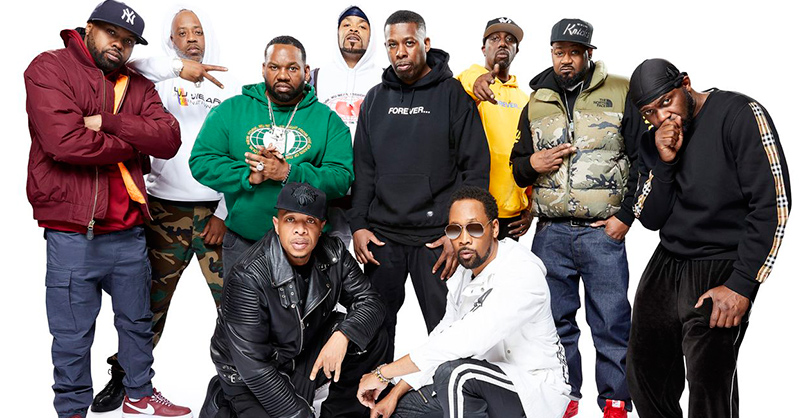
The Staten Island Shaolin Warriors receive the Global Impact Award at Memphis’s Power of Music Honors — and a Rock & Roll Hall of Fame induction is already locked in for later this year. Protect ya neck, and your legacy.
Some legacies don’t need defending. Thirty-plus years in, nine members deep, one timeless slogan tattooed on the DNA of every rapper who ever picked up a microphone — Wu-Tang Clan is a monument. And Memphis just gave them their due.
The Soulsville Foundation’s second annual Power of Music Honors, held at the Crosstown Theater in Memphis, Tennessee, celebrated people and organizations who carry music beyond performance — and this year, the event’s prestigious Global Impact Award went to New York’s own hip-hop royalty: Wu-Tang Clan.
Global impact. That phrase doesn’t get thrown around lightly, and it shouldn’t. Consider what Wu-Tang actually built: a sui generis sonic universe that fused Staten Island street knowledge with Shaolin mythology and five-percent philosophy, wrapped in RZA’s revolutionary lo-fi production aesthetic. They didn’t just make records — they created a genre ecosystem that spawned solo careers, films, comic books, fashion lines, and a cultural vocabulary that still shapes hip-hop discourse in 2026. Global impact is an understatement.
Now a nine-member collective following the 2004 death of Ol’ Dirty Bastard, two members of the Wu were on hand in Memphis Thursday night to accept the award: Cappadonna and Masta Killa.
Cappadonna, never at a loss for words, delivered the kind of unfiltered clarity that made him essential to the Clan’s legacy in the first place.
“It feels cultural, feels educational, feels spiritual,” Cappadonna told Action News 5. “I’m just glad to be here, man. I’m glad to be in the midst of all of this loveliness… talking about music and talking about love and talking about people talking about culture. That’s what hip-hop is all about, man.”
That’s Cappa. No filter. All truth. And he’s right — that’s exactly what hip-hop is about. Which is precisely why a recognition like this one, given by a foundation rooted in Memphis soul and presented to a group rooted in New York hardness, makes perfect cultural sense. The lines between what Memphis built and what Wu-Tang built are straighter than people acknowledge. Both traditions are about transformation — taking pain and poverty and turning it into something transcendent.
Later this year, Wu-Tang Clan will be inducted into the Rock & Roll Hall of Fame.
Read that sentence again. The Rock & Roll Hall of Fame. The institution that once seemed determined to pretend hip-hop didn’t exist — or at best, treated it as a visiting exhibit — is inducting the Wu-Tang Clan. That is not a small thing. That is the mainstream cultural apparatus finally doing what it should have done a decade ago.
And it matters beyond the ceremony. Every Wu-Tang Hall of Fame induction broadens the aperture of what gets considered “important” music in America. It makes it harder for future gatekeepers to exclude future hip-hop artists. It’s a precedent written in the language of legacy.
Grammy-winning Clan member Method Man is also scheduled to perform with the group this Saturday at the Riverbeat Music Festival in Memphis.
So the Wu isn’t just receiving awards — they’re still on stage, still in the room, still performing. That matters. In an era where legacy acts coast on nostalgia, Wu-Tang remains an active creative and cultural force.
The Power of Music Honors isn’t just another awards show — it’s part of a growing recognition that music’s impact extends far beyond charts and streaming numbers. The Soulsville Foundation, rooted in the legacy of Stax Records and Memphis soul, understands that music is infrastructure. It builds communities, preserves identity, and crosses lines that politics and commerce cannot.

Wu-Tang Clan has always understood this instinctively. From Staten Island housing projects to the global stage, from ODB’s chaotic genius to RZA’s disciplined sonic architecture, from the debut of Enter the Wu-Tang (36 Chambers) in 1993 to this award in 2026 — the story of Wu-Tang is the story of hip-hop refusing to be contained.
C.R.E.A.M., indeed. Culture Runs Everything Around Me.
Wu-Tang is forever. Memphis just put it in writing.


