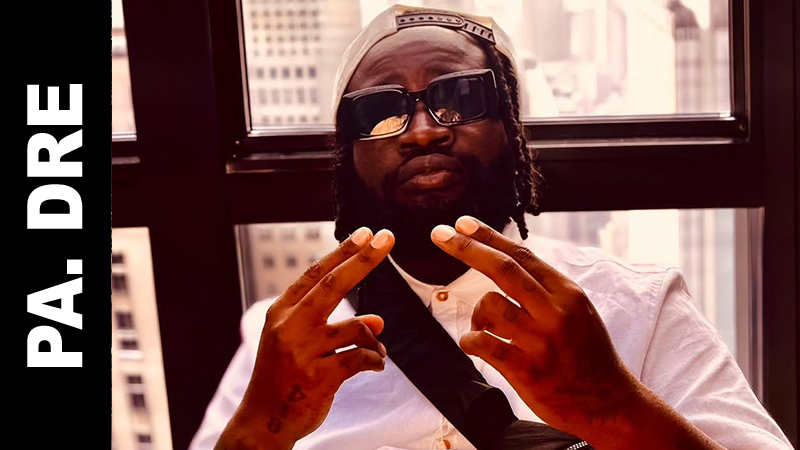
PA. DRE: Remember The Name. Respect The Work. (Interview)
By: Todd “DG” Davis
Rapindustry.com
___
Before PA. Dre ever made a beat, music was already in his blood.
Born in Memphis, raised in Northwest Pennsylvania, and now based in Sacramento, his journey runs from family musical roots to the heart of hip-hop’s underground. His father, a percussionist, played on Anita Ward’s “Ring My Bell,” while his grandfather played percussion on the original Shaft theme. For PA. Dre, though, that history wasn’t some grand introduction to the business—it was simply the soundtrack of home.
At eight years old, he got his first keyboard, and listening became creating. That curiosity eventually grew into Mydus Tuch, his early work with the Underground Family, where he wasn’t just making music—he was producing, rapping, directing creatively, selling albums, performing, making MTV commercials, and even landing on the cover of the Meadville Tribune. Young, hungry, and figuring it out as he went, he learned early that waiting for an opportunity wasn’t the move. You created one.
The road wasn’t always smooth. Groups dissolved, life happened, and hard lessons came with it. Wyldboiz Ent. with Stephon Streets and Vise Versa with his cousin Pree became important chapters, teaching him about chemistry, loyalty, relationships, and knowing that sometimes the music stops without the brotherhood having to.
Then came RJ Payne. Their 2015 connection was immediate, eventually leading to Beautiful Payne ENT, Max Payne, and The Ghost Of tribute series honoring Big L, Prodigy, Big Pun, and Sean Price. It was a partnership built on instinct—PA. Dre creating the canvas, RJ knowing exactly how to attack it.
That same ear has continued putting him in rooms with serious lyricists: Inspectah Deck, Mickey Factz, Ras Kass, Kxng Crooked, Queen Herawin, CZARFACE and others.
But the latest chapter deserves its own spotlight.
PA. Dre recently brought his production to Ice-T’s Criminal Migraine, a dope-ass LP that feels like a return to form for one of hip-hop’s true originals. Working with Ice-T isn’t about chasing nostalgia—it’s about helping an icon sound like himself while giving the music enough muscle to live in the present. PA. Dre’s production helps provide that foundation across standout cuts including “It’s All About…,” “You Can Get It,” and “Lost My Mind” featuring Treach.
That’s a pretty damn good place to be after all these years. From the keyboard he received at eight to the Underground Family, from Mydus Tuch to PA. Dre, from the early crews to Beautiful Payne ENT and now sharing production space with one of hip-hop’s foundational voices, the journey has covered some serious ground.
And through it all, the influences remain—RZA, Pete Rock, Havoc, J Dilla, Q-Tip, Large Professor, DJ Premier, Dr. Dre, Timbaland—but PA. Dre isn’t trying to sound like any of them.
He took the lessons, found his own pocket, and kept moving.
The geography changed. The industry changed. The equipment changed. The hunger didn’t. PA. Dre is still listening for that feeling—and judging by the records, he’s still finding it.
____
Q. PA. Dre, your story starts in Memphis, moves through northwest Pennsylvania, and now lands in Sacramento, but music was already in your blood. Your father played percussion on Anita Ward’s “Ring My Bell,” and your grandfather played percussion on the original Shaft theme. What did growing up around that kind of musical history teach you before you even realized you were learning?
Honestly, music was just normal to me. I didn’t grow up looking at it like, “Oh, I’m from a musical family.” That was just my life.
My father was a percussionist, and my grandfather played percussion on the original Shaft theme. My dad also played on Anita Ward’s “Ring My Bell.” So I was around people who actually made records, not just people who listened to records.
My father was probably my first real music critic. He was very honest with me. He wasn’t going to tell me something sounded good just because I made it. If something wasn’t right, he was going to tell me. At the time, you might not always appreciate that, but looking back, that was probably one of the best things he could have given me. It taught me to listen. Really listen.
I think that’s where a lot of my producer mentality came from. I learned that music is about feeling, but it’s also about knowing when something works and when it doesn’t.
Q. You got your first keyboard at eight years old, and that eventually turned into production. Do you remember the first time you realized you could actually create something from scratch—not just listen to music, but build it?
I remember getting my first keyboard when I was eight. That was a big moment for me because I wasn’t just listening to music anymore. I had something in front of me that I could actually make sounds with.
At that age, you’re just experimenting. You’re pressing keys, trying different sounds, and figuring out what sounds good together. But somewhere along the way, I realized, “I can actually make something.” And once I got that feeling, I never really stopped.
Eventually, I got into equipment like my Yamaha 4-track, the SP-202, the Boss DR-550, keyboards, and different pieces of gear. I was always trying to figure out how to put things together. I think that’s still the part of production I love the most. You start with nothing, or maybe you find one sound that catches your ear, and then you build an entire world around it.
Q. You’ve talked about hearing N.W.A.’s “Fuck Tha Police” and then being inspired by Dr. Dre and Snoop Dogg’s “Nuthin’ but a ‘G’ Thang.” Those are two very different records, but both were powerful introductions to what hip-hop could sound like. What did those records unlock in you?
Those records showed me that hip-hop could make you feel something in completely different ways. When I heard “Fuck Tha Police,” that was powerful because it wasn’t just somebody rapping. There was anger, frustration, and reality in it. It made you pay attention.
Then you hear “Nuthin’ but a ‘G’ Thang,” and it’s a completely different feeling. The production was smooth, the groove was crazy, and everything had space. That really made me start paying attention to the producer.
I wasn’t just hearing the rapper anymore. I was hearing the drums. I was hearing the bass. I was hearing the samples. I was hearing how the whole record was put together. That’s when I started realizing that production could actually change the way somebody feels. And I think that’s what I chased from that point forward—the feeling.

Q. By 1996, you were Mydus Tuch with the Underground Family, wearing multiple hats as producer, artist, and creative director. You were making MTV commercials, selling albums, performing, and even landing on the cover of the Meadville Tribune. What do you remember most about that early chapter when you were simply young and hungry enough to believe anything was possible?
I remember being young and not being afraid of anything. We really believed we could do this. We weren’t sitting around waiting for somebody from the industry to come save us. We were making our own music, selling our own albums, performing, doing whatever we had to do.
I was Mydus Tuch at that time, and I was doing a little bit of everything—producing, rapping, directing creatively. We even ended up doing MTV commercials and getting on the cover of the Meadville Tribune. When you’re young, you don’t necessarily understand how special some of those moments are. You’re just thinking, “We’re doing it.”
Looking back now, that hunger was important. We didn’t have all the resources. We didn’t know everything about the business. But we had the belief. And honestly, I’ve carried that same mentality with me ever since. If I believe in something, I’m going to figure out how to make it happen.
Q. Life took you through some hard turns, the group eventually dissolved, and you came out the other side as PA. Dre. Without romanticizing the struggle, how did those experiences change the man, producer, and artist you became?
I don’t want to make the struggle sound glamorous because it wasn’t. There were things that happened in my life that I had to take responsibility for. There were consequences. There were people I disappointed. There were times when I had to really look at myself. But those experiences changed me. When you’re younger, you can think everything is about right now. As you get older, you start understanding that your decisions have a bigger impact. I became more patient. I became more serious about my life. And I learned that talent isn’t going to save you if you don’t have discipline behind it. Music also became different for me. I had more life to pull from.
PA. Dre wasn’t just another name. It represented a new chapter.
I had already been through things, and now I had to decide what I was going to do with the rest of my story.
Q. You later formed Wyldboiz Ent. with Stephon Streets, then Vise Versa with your cousin Pree in the early 2000s. Looking back at those different crews and eras, what did you learn about chemistry, loyalty, and knowing when it’s time to take music more seriously?
Those different groups were all important chapters in my life. But one thing I definitely want people to understand is that just because you stop making music with somebody doesn’t mean you stop loving that person or that the relationship is over.
Me and Stephon Streets are still close like brothers to this day. We just haven’t made music together in years.
When you’re younger, you can sometimes think that everybody has to stay on the same path forever. As you get older, you realize that’s not how life works. People grow, responsibilities change, life happens, and sometimes the music takes you in different directions. But the bond can still be there.
Wyldboiz Ent. was an important part of my development, and Stephon was an important part of that chapter. Vise Versa with my cousin Pree was another chapter that taught me different things. I learned a lot about chemistry, loyalty, and relationships. I also learned that being loyal to somebody doesn’t necessarily mean you have to keep doing the same thing together forever.
Sometimes the music stops, but the brotherhood doesn’t. And those experiences helped me understand that relationships are bigger than a song, a group, or a company.
Q. In 2012, you finished in the Top 10 out of roughly 40,000 producers in the PRhyme Producer Remix Challenge with Royce Da 5’9″ and DJ Premier. What did that moment mean to you as a producer, and did it validate some of the work you had been putting in when nobody outside your circle was necessarily watching?
That was a big one for me because you’re talking about roughly 40,000 producers. To make that Top 10, you know somebody outside of your immediate circle heard what you were doing and thought it was good enough to stand out. And the fact that it was connected to Royce Da 5’9″ and DJ Premier made it even more meaningful.
Premier is one of those producers I’ve always respected. So to be involved in something connected to that world and make it that far was validation. Not validation like, “I’ve made it.” More like, “Okay, I’m not crazy. The work I’ve been putting in actually means something.”
Because a lot of producing happens in the dark. You’re making beats when nobody’s calling you. You’re experimenting when nobody is listening. So moments like that remind you that somebody is hearing it. And then you go right back to work.
Q. Then comes RJ Payne. You two connected in 2015, the chemistry was immediate, and that relationship helped build what became Beautiful Payne ENT. You produced the majority of Max Payne and went on to create The Ghost Of series honoring Big L, Prodigy, Big Pun, and Sean Price. What made that partnership click, and what happens when two people understand the music without having to over-explain it?
RJ and I started working together in 2015, and when we connected, the chemistry was pretty immediate. There wasn’t a lot of explaining that needed to happen. I’d send something, he’d hear it, and he understood what I was trying to create. And when he started putting his vocals on it, he could take the music somewhere I didn’t necessarily expect. That’s rare.
A lot of times, an artist and producer can be talking about the same record but hearing two completely different things. With RJ, there was an understanding. That’s what allowed us to build what became Beautiful Payne ENT and create projects like Max Payne and The Ghost Of series. And those Ghost Of projects were special because we weren’t just making records. We were paying homage to people who meant something to us—Big L, Prodigy, Big Pun, and Sean Price. RJ understood how to take those concepts and make them his own, and I understood how to create the musical environment for him to do that.
When the chemistry is right, you don’t have to force it. You don’t have to sit there and explain every little thing. Sometimes you make the beat, the artist hears it, and you already know where it’s going. That’s what happened with me and RJ.
Q. Your production résumé has grown into some serious company—from Ice-T, Inspectah Deck, and Mickey Factz to Benny the Butcher, Method Man, Raekwon, Havoc, Ransom, Skyzoo, Ras Kass, and a long list of respected underground heavyweights. What are you listening for when an MC gets in front of one of your beats?
I’m listening for personality. I want to hear who you are. I don’t care if you’re technically the best rapper in the world if I can’t feel anything when you’re saying it. I’m listening to your voice, your delivery, your pocket, your writing, and how you respond to the beat. Because the beat is supposed to give you something.
Sometimes I’ll make a beat and think I know exactly what it is, then an artist gets on it and completely changes my perspective. That’s one of my favorite things about producing.
The best producer-artist relationships aren’t about one person controlling everything. It’s about both people bringing something to the record. I give you the canvas. Now show me what you’re going to paint.
Q. You come from a musical family, but you also pull from producers across generations—RZA, Pete Rock, Havoc, J Dilla, Q-Tip, Large Professor, DJ Premier, Dr. Dre, Timbaland, and others. How do you honor that lineage without becoming trapped by it, and what makes a PA. Dre beat a PA. Dre beat?
I think you have to respect where you came from without being afraid to move forward. I grew up listening to RZA, Pete Rock, Havoc, J Dilla, Q-Tip, Large Professor, DJ Premier, Dr. Dre, Timbaland, and a lot of other producers. You can hear those influences in me because that’s part of my musical DNA. But I’m not trying to make a RZA beat or a Premier beat. I’m trying to make a PA. Dre beat.

For me, it usually starts with the sample. I don’t like forcing samples just because they’re supposed to be good. I want something that gives me a feeling. Something that catches me in the chest. Once I find that feeling, then I start chopping it, putting drums around it, finding the bass, adding keys if necessary, and building the record.
That’s where my identity comes in. The influences are there, but the final product has to sound like me.
Q. You’re now based in Sacramento and running First Letter Enterprises while continuing your work as a producer, artist, and director. What does this chapter look like for you? Are you focused more on building records, developing artists, directing visuals, or bringing all those pieces together?
This chapter is bigger than just making beats. I’m still a producer. That’s never going away. I’m still an artist. I’m still creative. But I’m also thinking more about the bigger picture now.
With First Letter Enterprises, I’m interested in building something that can exist beyond one song or one project. That could mean producing records. It could mean developing artists. It could mean directing visuals. It could mean putting different creative pieces together.
I’ve spent decades learning how music works, learning people, learning the business, and learning from my own mistakes. Now I want to use all of that. I’m not interested in putting myself in one box anymore. If I can produce, I’m going to produce. If I can help develop something, I’m going to develop it. If I can direct it, I’m going to direct it. I’m trying to build the whole picture.
Q. When you strip away the credits, the names, the projects, and the production résumé, what do you want people to understand about PA. Dre? From that first keyboard at eight years old to the Underground Family, the setbacks, RJ Payne, The Ghost Of, and everything still ahead—what’s the legacy you’re building?
I want people to understand that I’m still here. That’s probably the simplest way I can put it.
I got my first keyboard when I was eight years old. I went through the Underground Family. I was Mydus Tuch. I built with different people and different crews. I made mistakes. I went through some very difficult things. I had to rebuild myself. Then came PA. Dre.
Then, in 2015, I connected with RJ Payne, and we built another important chapter together—Max Payne, The Ghost Of series, and everything that came from that relationship.
And then there’s all the other artists, records, and experiences that have become part of my journey. But I don’t look at any of that as the end of the story. It’s all part of it.
I’ve learned that longevity isn’t about always being the biggest name in the room. Sometimes longevity is simply continuing to create when the room changes. I’ve been doing this for a long time, and I still get excited when I hear a sample that gives me that feeling. I still get excited when I hear an MC take one of my beats somewhere I didn’t expect.
So what am I building? I’m building a legacy of somebody who never stopped. I want people to look back and see the whole journey—not just the credits.
See where I started. See the people I came up with. See the relationships that lasted even when the music stopped. See the setbacks. See the rebuilding. See the records. And then understand that through all of it, I kept creating.
I’m not finished yet. That’s probably the most important part of the story.


