
By: Todd “DG” Davis
Rapindustry.com
___
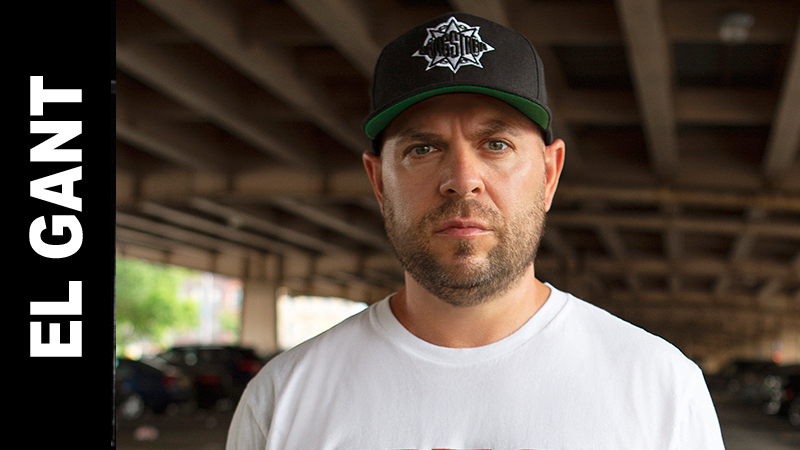
El Gant has spent more than two decades proving that longevity means nothing if the pen doesn’t keep pace.
From four championship runs on MTV’s Direct Effect to Beast Academy, the deeply personal O.S.L.O., Gantatello and Jamo Gang alongside Ras Kass and J57, the New York lyricist has never strayed far from the foundation: bars, wordplay, craftsmanship and respect for the culture. Somewhere along the way, a coveted DJ Premier co-sign became collaboration, mentorship and genuine friendship. But the years did more than build a résumé. They gave the rhymes something to carry.
On House of Cards, his collaborative project with maticulous, Gant turns that experience toward growth, technology, distraction and a world becoming increasingly disconnected while staring into screens designed to keep us connected.
The battle-tested MC remains. The hunger remains. The difference is perspective.
El Gant once rhymed to prove he belonged. Now he rhymes like a man who knows exactly why he’s still here.
___
Q. Before the records, tours, DJ Premier co-signs and Jamo Gang, you were making your name in battles—including four championship runs on MTV’s Direct Effect. Who was El Gant before people knew the name, and what did having to prove yourself face-to-face teach you that still lives in your approach today?
I don’t really know who I was because I was so young! I jumped into the game in my late teens, and the environment surrounding hip-hop was so different in the late ’90s. I definitely thought I was confident, but I realize now I wasn’t because a lot of decisions I made were to overcompensate for my insecurity at that age. I did know that I was talented. I think back then battling was a way to get on; it wasn’t as big of a thing and separate like it is now. I did it for the exposure because I spent so much time battling kids in the cafeteria, and later at bars and outside cyphers, to test my skills and get my name out there.
Q. Your name stands for “Everything Lacking Greatness Accomplishes Nothing Tangible.” After more than two decades of wins, setbacks, reinvention and perseverance, does that acronym mean something different to you now than it did when you first coined it?
Great question! I think I’m more concerned with the intangibles now than the tangibles. Peace, happiness, no stress. Money comes and goes, and I’m way less concerned about the things you can touch since those are the ones that can make someone do crazy things.
Q. There’s longevity, and then there’s remaining sharp. From It’s Over and Beast Academy through O.S.L.O., Gantatello and now House of Cards, your pen has evolved without abandoning the fundamentals. What can the El Gant of 2026 do as a writer that the hungry battle MC coming up couldn’t?
I think one of them is having experience. I saw a lot. Death, drugs, love, money, lust, pleasure and pain. I think back then my sole purpose was to prove myself, and that entailed being as fast and witty as possible. I think once you stop evolving, you stop being an artist. I’m blessed to still be here, so I enjoy taking a breath, exploring cadences when rhyming, and really painting my picture as best as I can now that I’ve been in it for so long. I feel like I have so much to talk about still and really enjoy doing it.
Q. House of Cards feels especially timely—the record deals with personal growth while looking at technology, distraction and the cracks within the world around us. What was happening internally and externally that made this the record you and maticulous needed to make now?
I think also, as I have gained more experience in life, I’m finding more importance in things that fulfill me. And I feel as if a lot of what’s going on right now is designed to keep your head in the sand. I live in NYC, where everyone is constantly buried in their phone. That mindset stifles creativity, keeps corporations handling us like puppets, and makes us complacent to war and atrocity since nothing seems important for too long and we are always scrolling to the next thing. It’s by design. This is why so much of this album is centered around that.
Q. maticulous comes from that tradition where the producer isn’t merely supplying beats—he’s helping construct an entire world for the MC. What did his production pull out of you lyrically, and when did you realize the chemistry was strong enough to carry a full album?
I’ve known maticulous for a few years, and I was always a fan of his work. He’s a dope producer and a genuine dude. I think it’s when we started stepping into the studio where I really saw who he was and gravitated towards it. He originally sent me some beats and I wrote some sketches to them, but once we got in the lab, he was a monster. He had no problem pushing me to my limits, and I appreciated that a lot. No yessing me to death; he knew what he wanted, and we worked really well together because of that.
Q. “Wordle” pairs you with Brother Ali—two MCs who have always treated words like they actually matter. In an era of shorter attention spans and disposable content, how important is it to you to still make records that reward somebody for really listening?
I think at the end of the day, timeless music will always involve, for the most part, words that matter. Just like books and poetry. Trends come and go, but we never remember them. We remember the ones whose words resonated with us. That’s why we wanted Brother Ali on this. He is powerful, insightful and, if you didn’t know, one of the best MCs I’ve ever seen live.
Funny story: I first met him years ago, playing a show in Jackson Hole, Wyoming, for a snowboard magazine. When he went on after me, he had the place lit! Suddenly, out of nowhere, in this 700-person room, Justin Timberlake randomly shows up and goes to grab a mic. At first, Brother Ali thought it was a random dude, but when his DJ pointed out who it was, Justin Timberlake started beatboxing while Brother Ali kicked a crazy five-minute freestyle. You can’t make this stuff up! These are the moments that inspire me as an artist.
Q. House of Cards also brings Ill Conscious, The Audible Doctor, Ferris Blusa, TENNIN, Alex “Zran” Razran and DJ Jon Doe into the fold. At this stage of your career, what earns somebody space on an El Gant album—bars, chemistry, friendship, what they add to the story, or some combination of all four?
Unfortunately, friendship isn’t always going to cut it, haha. I like a lot of MCs I’m not personally a fan of. It was a mixture. Some were artists maticulous ran by me that, once I heard, I thought fit very well since this is, after all, a joint project—Ferris Blusa and Zran being two of them. TENNIN, as well, was a singer he knew that blew me away when she sent the recording back for the hook. I wrote it and sung—horribly—a demo. She returned with greatness.
Audible Doctor and Jon Doe are friends with both of us, and I love what they both do, respectively. Ill Conscious was my idea. He had already worked with maticulous once, but I was a big fan, and we have a lot of mutual respect for each other, so I just reached out. Everyone involved played an intricate part and were perfect for what we were trying to create.
Q. DJ Premier has gone from somebody whose records you studied to a mentor, collaborator and longtime supporter. What has Preemo’s belief in you meant—not simply for the résumé, but for that kid who came into hip-hop wanting acceptance from the culture he loved?
It means the world to me, and still, sometimes, it’s unreal. More importantly, he became a very good friend. We talk all the time, and to be honest, 75 percent of the time it’s non-hip-hop-related, just bro stuff. We went and saw Rush a few weeks ago! He’s just an awesome human, and I appreciate him on multiple levels.
Q. You’ve lived through virtually every version of the independent rap business—physical records, major-label aspirations, mixtapes, blogs, downloads, streaming, algorithms and now AI. What have all those changes taught you about what can change around hip-hop versus what should never change within it?
You have to adjust to the times while always staying true to yourself. For example, I’m never using AI slop for artwork. When I see it with another artist, it automatically turns me off to them. I’m sure there are ways to integrate it artistically, but I still use artists I respect and admire, and I feel the fans appreciate it. Taking care in everything you do will always be timeless. It’s the same reason in the early 2000s I never put out rushed mixtapes. I’m still doing vinyl and sell them out every time. I think at the end of the day, you adjust to what brings in the listeners, but always treat the listener with respect. The rest will follow.
Q. Let’s bring it back to Jamo Gang. When you, Ras Kass and J57 first connected, the chemistry happened almost accidentally and quickly became something real. Looking back at Walking With Lions and everything surrounding that run, what made those three personalities and musical sensibilities fit together so naturally?

I think sometimes things just click. We have three distinct personalities. J57 can be a bit mysterious and only reached by a pigeon, Ras is the opposite and extremely extroverted, and I’m usually the I-dotter and T-crosser, and I think it just worked. We saw the great music we were making, and everyone played their part. I think also having three talented people without an ego helped considerably.
Q. Now there’s another Jamo Gang chapter taking shape. Without giving away what you’re not ready to reveal, what can you tell us about where you, Ras and J57 are taking it this time—and has everything each of you has experienced individually since Walking With Lions changed what Jamo Gang sounds like collectively?
I can say nothing! But if and when it happens, it will be our best work yet. We all continue to evolve, and the music will prove it.
Q. Between Gantatello, House of Cards and new Jamo Gang music, this feels less like an artist protecting yesterday than somebody still building tomorrow. After everything you’ve already accomplished, what still makes El Gant hungry?
I really love what I do, and I feel like now there is no pressure. That pressure brings stress, and that stress can be heard in the music. I think I still have so much more to expand on as my own consciousness changes, and that’s what makes me so hungry. When we realize that tomorrow isn’t promised, it’s almost a relief and motivates me even more.
Q. Twenty-plus years from now, when somebody traces the road from those early battles through Beast Academy, O.S.L.O., Jamo Gang, Gantatello, House of Cards and whatever comes next, what do you hope proves that “Everything Lacking Greatness Accomplishes Nothing Tangible” wasn’t merely a name—but the code you actually lived by?
My longevity, my evolution, my dedication to the craft and my reputation. If that doesn’t seal the deal, I don’t know what will!


