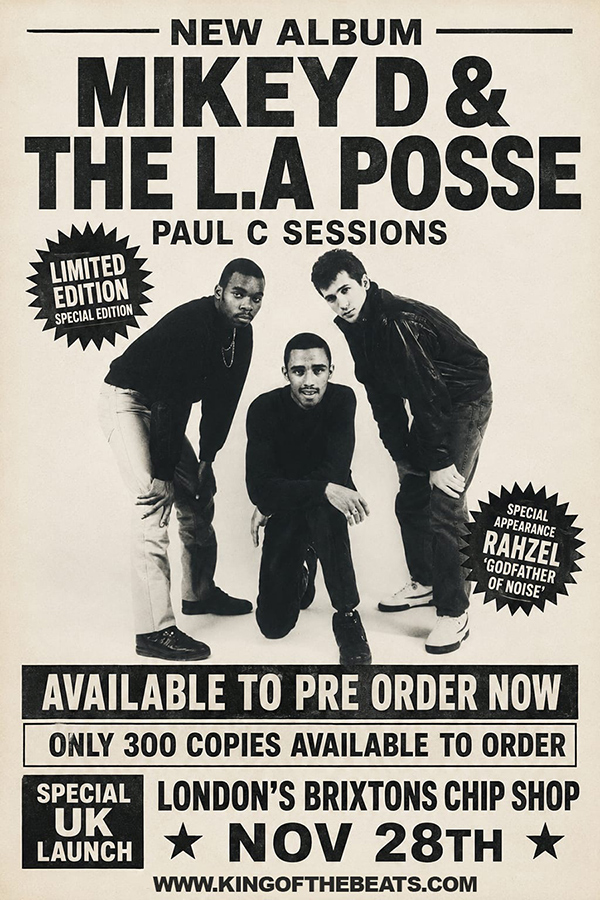

BEFORE IT WAS THE GOLDEN ERA: Mikey D & The L.A. Posse Were Already Making History (Interview)
By: Todd “DG” Davis
Rapindustry.com
___
Long before hip-hop history was divided into eras and movements, Mikey D was earning his name the old-fashioned way: rhyme-for-rhyme in Queens.
Born Michael Anthony Deering, the Laurelton MC came from a time when reputations were built in battles, not algorithms. His victory at the 1988 New Music Seminar Battle for World Supremacy confirmed what his neighborhood already knew—Mikey could rhyme with anybody.
But battling was only the beginning.
With Mikey D & The L.A. Posse, alongside DJ Johnnie Quest and the late, legendary Paul C McKasty, that raw talent became records like “I Get Rough,” “Dawn” and “My Telephone.” Rahzel, years before becoming The Roots’ “Godfather of Noise,” was part of those early sessions as well.
They weren’t recreating the Golden Era. They were living it.
Mikey’s road later led to Main Source, where he followed Large Professor and fronted 1994’s Fuck What You Think. Decades later, he remains active through new music and Pass The Torch Distribution, preserving the foundation while continuing to build upon it.
Now Mikey D & The L.A. Posse — Paul C Sessions brings everything full circle. The limited-edition vinyl puts Mikey’s rhymes, Johnnie Quest’s cuts, Rahzel’s vocal percussion and Paul C’s production back where they belong—together.
Mikey calls it “Newstalgic”: honoring yesterday without living in it. Because these aren’t simply old recordings pulled from a vault. They’re the sound of history before anybody in the room knew they were making it.
_____
Q. Before the accolades, the records, and everything that followed, take us back to Queens when this music was actually being made. What do you remember most about the environment that created Mikey D & The L.A. Posse?
Mikey D: I remember everything being innocent. Hip-hop was fresh to us. All the young cats around the way wanted to do it, and it was very competitive. Some of us took it seriously, some didn’t. Some did it as a hobby, but I was one of the guys who did it for real.
We didn’t even look at it as creating history. We looked at it as creating memories. Everything we did was natural. We were just living in the moment.
Q. People today talk about that period as the “Golden Era,” but you weren’t trying to make vintage hip-hop—you were simply making hip-hop. What did that time feel like from inside the culture before anybody knew it would become history?
Mikey D: It just felt new. It felt exciting and competitive. It was like a burst of brand-new energy.
It’s hard to even explain that feeling if you weren’t there, but it was definitely something special. It was a wonderful feeling that I still cherish and hold on to today.
Q. Paul C has become almost mythical to serious students of hip-hop, but you actually created with the man. Beyond his technical brilliance, what was Paul like in the room, and what did he hear in an MC that made his production different?
Mikey D: Paul C was a great engineer and producer with a great ear. Before becoming an engineer and producer, he also played live instruments in a band, so he had that musical background.
When we initially met Paul, he was making music out of his garage. The Clientele Brothers told us about him and introduced us. When I first heard Paul’s beats, I couldn’t believe this white guy was making them. Before he came out of that garage, just from hearing the music, I thought he was Black. That’s how much soul he had in his sound.
Once me and Johnnie Quest met him, it was a no-brainer for us to make music together. Paul was very quiet and unassuming. Upon initially meeting him, you wouldn’t necessarily expect him to be as great as he was. But once you heard what he could do, you understood.
Q. These recordings survived for decades before finally receiving this physical release. When you hear the Paul C Sessions today, what comes rushing back that somebody discovering them in 2026 could never hear between the grooves?
Mikey D: When I hear these joints now, it brings back memories of the very beginning, when everything was innocent. We weren’t planning on making records. We weren’t planning on making careers out of this. We were having fun, and everything was natural.
I remember those late-night sessions with Paul at 1212 Studios. This was right after he left his garage and got the job at 1212. He would call me and Johnnie Quest after midnight, when everybody else was finished recording. We’d go in there when there was spare studio time and just create, create, create.
Back then, I used to do most of my vocals in one take because punching in and editing weren’t as easy as they are today. The best thing you could be was a one-take wonder. Working with Paul definitely polished my skills and helped me become a recording artist.
Q. Paul’s life was tragically cut short before the world could fully understand his impact, yet his fingerprints run through generations of hip-hop production. How important is this release to giving Paul C his flowers and preserving another piece of what he contributed?
Mikey D: Paul has gotten his flowers over and over again, and rightfully so. With this album, because it had never come out on vinyl, me and Pritt Kalsi of King of the Beats Records in London thought it would be a great idea to finally do a limited-edition vinyl release.
But this isn’t only about giving Paul C his flowers. It’s giving Johnnie Quest his flowers. It’s giving me my flowers. It’s giving Rahzel his flowers. We were all in those rooms together.
People don’t always realize that Paul C was part of a group—the original L.A. Posse—and that’s us. A lot of times when Paul’s story gets told, we get cut out of the picture. That’s okay, because this album is here now to give all of us our flowers and preserve what we created together.
Q. There’s something fitting about these sessions finally being pressed on vinyl—the same format that helped build the culture itself. In an era of streaming and disposable releases, what does physically preserving this music mean to you?
Mikey D: It’s an absolute vinyl collector’s dream come true. These recordings come from a time when vinyl was a major part of how hip-hop was experienced, so to finally have these sessions preserved in that format means a lot.
We knew there were collectors and fans of our music who really wanted this on vinyl. That’s why we made it happen as a limited edition of 300 copies. Now they can actually hold this piece of our history in their hands.
Q. Rahzel appears here long before much of the world would come to know him as “The Godfather of Noise.” What do you remember about Rahzel during that period, and could you already tell that what he was doing with his voice was something different?
Mikey D: On these records, this was Rahzel’s first time doing the human beatbox on record. This was prior to The Roots. This was prior to all of that.
A lot of people also don’t know that Paul C used Rahzel’s voice on the bass line of “I Get Rough.” That’s part of the history, too. With this release, we want to make sure Rahzel gets his flowers and receives credit for everything he brought to the L.A. Posse.
Q. DJ Johnnie Quest’s scratches are another reminder that these records come from a time when the DJ wasn’t decoration—the DJ was fundamental. What did Johnnie bring to the chemistry and identity of The L.A. Posse?
Mikey D: Johnnie Quest was the greatest DJ that I knew. Me and Johnnie started out at the same time. My goal was to become the best rapper I could possibly be, and his goal was to become the best DJ he could possibly be.
For the time we were doing our thing together, I think we exceeded our own expectations. The DJ was fundamental to what we were doing, and Johnnie Quest was fundamental to the sound and identity of the L.A. Posse.
Q. Your own history stretches far beyond these sessions—from battling and earning your reputation in Queens to eventually becoming part of Main Source. Where do the Paul C recordings sit in the larger story of Mikey D becoming the MC people came to know?
Mikey D: These sessions represent the beginning of me becoming a recording artist. They took me one step beyond creating tapes and building my reputation in the streets.
Now people in the music industry were opening their eyes and ears to who I was. It took me outside of my comfort zone and into new territory. I wasn’t only a battle MC anymore. I was learning how to take what I could do as an MC and turn it into records.
Q. There’s a difference between celebrating hip-hop history and rewriting it after the fact. As somebody who actually lived through this foundational period, what do you think gets misunderstood, overlooked, or simply left out when people tell the story of early Queens hip-hop today?
Mikey D: They miss the who’s who. There are a lot of us who inspired a lot of what you hear today, but unfortunately, many of us get overlooked when the history gets told.
That’s another reason I look at this release as a time capsule. I want people to hear it today and know what we’ve done and where some of this came from. At the same time, I’m still active and continuing to create. That’s what I call “Newstalgic”—respecting where we came from while still creating something new.
Q. A project like this inevitably brings up the people, places, and moments that are no longer here. Has revisiting these recordings felt more like nostalgia, celebration, unfinished business—or a little bit of all three?
Mikey D: To me, it feels like a celebration of the life we had together and an opportunity to share that with a new audience.

It’s also for the collectors who wanted this vinyl so badly. We knew there were people who were really fans of our music and wanted to own these recordings physically, so we made it happen. We did 300 limited-edition copies for those collectors and for the people who have supported this music.
Q. Younger generations can now hear these sessions without nostalgia attached—they can judge the rhymes, beats, scratches, and rawness on their own merit. What do you hope a young MC or producer hears in this record about the craftsmanship hip-hop was built upon?
Mikey D: I want them to hear the organic authenticity. I want them to feel what it was like back then, when you couldn’t rely on punching in all the time. You had to be able to go straight through and deliver.
I also want them to hear the camaraderie between the four of us and how we came together and made it sound like one.
And I want younger people to understand that we’ve been around for decades, but it doesn’t matter how old you are. If you love it, keep going. We wanted to give the youth something they can listen to, learn from, and understand about the craftsmanship this culture was built on.
Q. After sitting in the vault all these years, Mikey D & The L.A. Posse — Paul C Sessions is finally becoming something people can hold in their hands. When that vinyl lands on the turntable and Paul’s production comes through the speakers again, what does it mean knowing that the music—and his name—will keep spinning long after all of you first made it?
Mikey D: It’s a sound that can’t be recreated or duplicated. That’s why we were the L.A. Posse. L.A. stood for Laurelton. Me and Johnnie Quest were from Laurelton, and although Paul was from Rosedale, we were the L.A. Posse.
When you put that record on and hear Paul’s production, the rhymes, the scratches, and everything we created together, you’re hearing the sound of the L.A. Posse.
That’s us. That’s our history. And now it keeps spinning.