
David “C-Doc” Snyder: Legacy on Loop (Interview)
By: Todd “DG” Davis
Rapindustry.com
___
David “C-Doc” Snyder has always operated just ahead of the curve—working where eras overlap, where ideas are still forming, and where the technology hasn’t quite caught up to the creativity yet.
He came up in hip-hop during its most transitional years, when the culture was moving from analog to digital and every new format changed how music was made, shared, and understood. That mindset stuck: stay close to the change, not the aftermath.
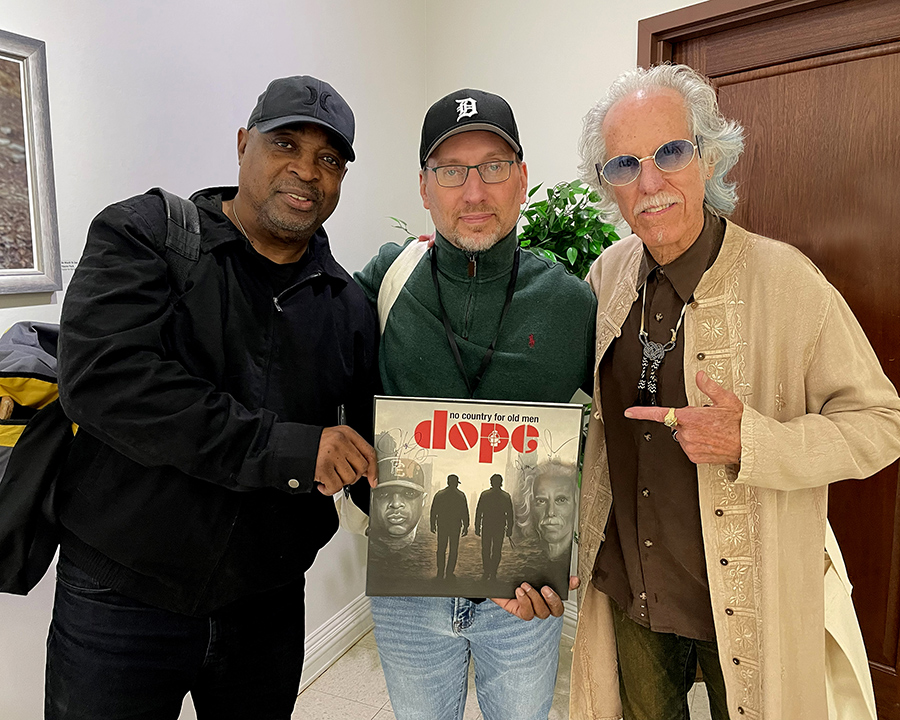
That perspective connects directly to doPE—Chuck D of Public Enemy and John Densmore of The Doors coming together on No Country for Old Men. It isn’t nostalgia or crossover marketing—it’s two distinct musical lineages meeting without compromise.
C-Doc’s role is to translate that meeting into something immediate and grounded in sound. He keeps the production focused, intentional, and unpolished in the right ways—so the impact feels present, not retrospective.
The result is music that doesn’t look back for approval or forward for validation. It just holds its ground in the moment where everything converges.
Before the titles and credits, what did hip-hop feel like to you when it first became something you couldn’t ignore?
It was all encompassing. Those were exciting times. Growing up as a white kid in the suburbs of Pittsburgh, PA, I didn’t really know what was going on with the culture beyond the little things that I saw and heard. I think it started with scratching—Herbie Hancock’s “Rockit” with DST. Then I got into breakdancing for a minute. Then there was novelty rap like “The Super Bowl Shuffle.”
One of my absolute favorite songs was Chaka Khan’s “I Feel for You.” I had no idea that Melle Mel was on that track. At that point, I didn’t even know who Melle Mel was. “Walk This Way” was half-dope to me when it came out—I loved the Run-DMC part but wasn’t really feeling the Aerosmith part. I can only assume that was because I was starting to get into soul, funk, and R&B at that point.
Then I heard LL Cool J’s Bigger and Deffer, and that changed everything. It became an all-consuming obsession. Then came Kool Moe Dee’s How Ya Like Me Now. My cousin John came to visit one weekend and brought Boogie Down Productions’ By All Means Necessary, and that made me realize there was something amazing going on that was bigger than just music and entertainment. When Yo! MTV Raps hit, I was all in.
Being part of The Impossebulls, what did it mean to build something “virtual” before the culture even had language for that kind of collaboration?
We knew it was special, but we didn’t think much of it beyond that. It was really just getting super creative and trying to make things happen in what would become a wild, wild west sort of situation on the internet. It was happening very quickly, and we were all learning on the fly.
To backtrack slightly, I may have been one of the first artists to collaborate using MP3s. This was in 1998 or 1999—I’m not exactly sure. A producer from the UK named Del sent me a beat, and I sent him my acapella back through email, and he put it together. When Chuck heard about it, he was blown away. That was the genesis of The Impossebulls.
From there, it was just figuring out what else we could do. This was all coinciding with Chuck’s Bring the Noise online radio station, the original RapStation supersite where you could upload music, and the eventual online version of the SLAMjamz label. We were having a blast with it.
What did working closely with Chuck D teach you about purpose in music beyond just sound?
I already had an idea about that before working with Chuck because I was such a huge Public Enemy fan from the start. With rap music—and Public Enemy especially—it was the soundtrack to damn near every move I made. It was there for good times, and it helped me get through tough times. I made friends through a shared love of the music.
So I already knew how important it was to me. These weren’t just albums to put on while driving in the car, although they could be that too. I’ve said for years that rap is one of the most important genres of music due to its ability to convey information directly and succinctly.
That’s not to say I haven’t learned anything from working with Chuck—I’ve learned so much over the years, and I continue to.
When producing for Public Enemy, how did you navigate honoring a legacy while still pushing it forward?
That’s the trick, right? I’ve always believed that being a superfan first is what allowed me to jump into the situation and contribute. I studied the classic records constantly—not just the sonics, but the approach, aesthetics, and visuals. When it’s your favorite group, you notice the details.
When I first started talking to Chuck, I asked all these nerdy questions about the minutiae. Maybe he thought I was nuts. But I was also sending him music I was creating, so he could see I wasn’t just talking—I was trying.
Very early on, I gave Chuck a CD full of beats and told him I wanted to produce the next PE album. He took it and filed it away, but it was obvious I wasn’t ready for that yet. A few years later, he asked about those tracks, and I told him most of them were trash. Only one resurfaced later as the intro “Either You Get It by Now or You Don’t” on New Whirl Odor.
For me, it’s about finding the sound. I usually know when something feels right for Public Enemy. Sometimes Chuck picks something else I don’t hear that way, but I start with the sonics and build from there. Thankfully, he gives me a lot of freedom in finishing the tracks.
Tracks like “Superman’s Black in the Building” carry cultural weight—what mindset do you enter when creating something that has to say more than just music?
Honestly, Chuck is the one who brings the weight to it. My job is to give him the sonic backdrop that carries those words in a way fitting of a Public Enemy record. Once I hear where he’s going, I can add sounds, samples, and textures to help drive it home. But it always starts with him.
Having worked with artists like Stetsasonic and Chill Rob G, what separates that era’s foundation from how artists move today?
It’s a difference in work ethic and expectations. The classic artists have seen and been through a lot—the highest highs and the lowest lows. The real question now is: why do they continue to make music?
If it’s creation for creation’s sake—pure love for the music, art, and culture—then I can do what I do and hope they appreciate it. I’m not living large by any means, and that’s not what I’m trying to do. I just want to contribute to a culture that has given me so much.
My love for it supersedes everything else. If I can make something dope that helps someone get through their day, I’ve done my job.
Also, working with Public Enemy, Stetsasonic, Chill Rob G, Sadat X, Chubb Rock, Speech, Wise Intelligent—these are my musical heroes. It’s mind-blowing.
When did you realize your storytelling couldn’t be contained to audio alone and needed to expand into film?
What’s funny is I had no idea I was going to be a music producer. I did music as a hobby. I just happened to obsess over hobbies until I got good at them.
I started making films as a kid with my brothers, cousin, and friends. I planned to get into filmmaking at any cost—I even went to film school for a bit. So that was always there.
It became useful when we started The Impossebulls because I could make music videos quickly and cheaply, which led to my first professional filmmaking gigs.
Across directing multiple films, what stories are you drawn to that music alone could never fully express?
A Prince Among Thieves by Prince Paul showed me you could really push storytelling through sound. That’s something I’ve always wanted to do, but I just haven’t found the story yet.
With film, it’s about visuals—how to convey as much information as possible through images. I’m always studying that.
Luckily, we have a great screenwriter, Jillian Holt, who we work with. My job is to translate her scripts into a visual medium with maximum impact. I also just like making films that look cool, so I’m always trying to put the camera in interesting places.
Returning to your own music with Divided We Stand, what did reconnecting with your personal voice reveal after years of building behind the scenes?
Divided We Stand was a funny situation. Michael Gregoire, who was art director at SLAMjamz, started a netlabel called blocSonic and invited me to do remixes.
I was in between things creatively and just trying to stay afloat. When I saw what he was doing, I got inspired and asked if I could do an album. He said yes, but the first release slot was about a year away. I was surprised, but I agreed—and then forgot about it.
A year later, I’m in pre-production on my third film, and Mike emails me asking if I still want to release the album. I realized I’d messed up, but I didn’t want to let him down.
I dug through old material and quickly finished a single: “Far Gone” b/w “Due This.” He loved it and wanted the album.
Over two weeks, I basically Frankenstein’d the record together using unfinished ideas and scraps. I didn’t overthink it. I just tried to make it fun, a little goofy, but still enjoyable—and it worked.

Through “It’s C-Doc Again!”, what have conversations with hip-hop pioneers shown you about what history tends to overlook?
Harry Allen once said—via The Roots—that hip-hop is often treated as disposable product. Talking to legendary artists on It’s C-Doc Again! really drives that home.
We have to do better preserving this culture. It’s our responsibility. There are so many stories beyond the usual ones people repeat.
I didn’t know about Mr. Schick until we interviewed him—the first bilingual MC. That’s the kind of knowledge that needs to be preserved. There’s so much more than debates about Illmatic vs. It Was Written.
As president of SpitSLAM, how do you preserve authenticity in a culture that moves faster than it reflects?
I decided early that I wanted the label to focus on classic sounds—boom bap, old school, music that carries the tradition I grew up on.
If Chuck brings something outside that lane, I’m not going to say no. But when I talk to artists, I try to keep that direction clear.
When you’re building something small, you need a niche people can recognize and trust. I wanted people to know what they’re getting when they see a SpitSLAM release. That consistency is how we’ve slowly built trust with listeners.
Looking across your entire journey—from digital innovation to film and legacy work—what part of your story is still being written in real time?
Honestly, all of it. There’s still so much to do.
The next step is working with major labels to access neglected legacy catalogs and bring them back properly. The vinyl and cassette resurgence shows people still want this music.
But I’m also a creator. I’m always full of ideas, and I get to work with Chuck D, who is one of the most creative people I know. He always has something new to build, so it keeps everything moving.