

THE GREAT PESO [The Fearless Four]: Before The World Caught On, Harlem Was Already Rockin’ It (Interview).
By: Todd “DG” Davis
Rapindustry.com
___
There was a time when Hip-Hop didn’t come with a corporate backing, a marketing budget or a guaranteed seat at the table. It came from the concrete, the corners, the parks and the recreation centers — where DJs commanded the sound system, MCs earned their stripes on the microphone and reputations were built in front of the people, not manufactured for an audience. It was a culture still finding its voice, and out of Harlem, New York, came a crew that would help take that voice somewhere it had never been before. The Fearless Four weren’t waiting for Hip-Hop to make room for them. They were making history on their own terms.
Originally rooted in the Houserockers Crew, founded by Devastating Tito and Master O.C., the group evolved into a six-man outfit that brought together four distinct voices and two DJs: The Great Peso, Devastating Tito, Mighty Mike C and Microphone Wizard DLB, alongside Master O.C. and Krazy Eddie. Six personalities, one collective identity and a sound that reflected the imagination, innovation and competitive spirit of an era when originality wasn’t optional — it was everything.
Their arrival on wax was more than another entry in the growing catalog of early rap records. With “Rockin’ It,” the group delivered an electro-infused classic that married their lyrical presence with the futuristic pulse of Kraftwerk’s “The Man-Machine.” Released in 1982, the record became a defining moment in their catalog, found a lasting place in Hip-Hop’s sonic vocabulary and reached another generation through its appearance in the groundbreaking documentary Style Wars. Follow-up material, including “It’s Magic,” further demonstrated their willingness to experiment with sound and push beyond the boundaries of what rap records were expected to be.
Then came a milestone that put their name in the industry’s history books: in 1983, The Fearless Four became the first rap group signed to a major record label, Elektra/Asylum Records. At a time when the music business was still figuring out what to make of Hip-Hop, these Harlem representatives were already proving its commercial and creative possibilities. Their breakthrough wasn’t simply about securing a deal; it was about opening a door that would make the journey a little less unfamiliar for the crews and artists who followed.
The firsts kept coming. They became the first rap group featured at the New Music Seminar and the first to appear on The Joe Franklin Show, carrying Hip-Hop into rooms and onto platforms where the culture had rarely been represented. Their 1983 collaboration with Kurtis Blow, “Problems of the World Today,” also revealed another dimension of the group — one willing to look beyond the party and the performance to address the realities surrounding them. They weren’t confined to one sound, one subject or one moment in time. That was part of the appeal.
The years would bring changes, reunions and another chapter with their 1994 album, Creepin’ Up on Ya, but the significance of The Fearless Four was already firmly established. Their story is woven into that formative stretch when Hip-Hop was developing its identity, testing its reach and beginning to discover just how far it could travel. And while the culture has grown into a global phenomenon, its foundation remains rooted in the contributions of those who helped build it before the world was watching.
That’s why their flowers are long overdue — and why this story deserves to be told beyond a greatest-hits playlist or a passing mention in an old-school lineup. The Great Peso. Devastating Tito. Mighty Mike C. Microphone Wizard DLB. Master O.C. Krazy Eddie. Learn the names. Respect the contributions. Understand the history.
Because before Hip-Hop had an industry, The Fearless Four helped show the industry what Hip-Hop could be. Harlem gave the world the crew. The crew gave the culture some of its history. And decades later, their place in that history remains undeniable.
First to break through. Fearless by name. Fearless by nature. Still Rockin’ It.
_____
Before Hip-Hop became a global phenomenon, it was neighborhood culture — park jams, block parties, schoolyards, recreation centers and DJs bringing people together. Take us back to Harlem in those early days. How did The Fearless Four come together, and what was happening around you that helped shape the group and its sound?
THE GREAT PESO: This is Peso 131 from The Fearless Four. We came together through graffiti writing. Master O.C. wrote “Rate One,” Tito wrote “T-One,” and I wrote “Peso 131.” We were graffiti writers, running kind of wild in the streets, while listening to Hip-Hop groups like the Furious Five, the Romantic Five, the Cold Crush Brothers and the Treacherous Three.
My younger brother had a crew called The Family, which Mike C was part of. Eventually, O.C. and Tito said, “Yo, we should get into this.” That’s how it happened. They talked me into getting involved because, like I said, we weren’t rappers; we were graffiti artists who liked what was happening.
We started out as a house-rocker crew, and Tito and I used to write routines and things like that. Still, I wasn’t sure about my skills because I was listening to other people. But once we recorded what we were doing, people started saying, “Yo, that sounds kind of dope.” From there, we just kept going.
As far as how we met Mike C and DLB, everything happened by fate — almost by accident. Mike C was running with my brother, Mr. Nasty Kenny G, in their crew. Mike C also used to run with my cousin, Marky, as a two-man crew. Mike C and Marky put together a talent show, and Tito and DLB got involved. Those three clicked, thought it was pretty cool, and Tito brought them to the house.
Like I said, we all knew each other, even though we weren’t really running together in the streets. That’s how everything came together.
“Rockin’ It” arrived in 1982 and became much more than another record in the crates. It captured a moment when Hip-Hop was experimenting, expanding and finding its musical identity. What do you remember about creating the record, and when did you first realize you had something special on your hands?
THE GREAT PESO: Our first record was “It’s Magic.” We got a record deal with Enjoy Records because of Mike C. He knew Bobby Robinson and stayed on him. Actually, Mike wasn’t even going to school at the time. He was just hanging out with Bobby Robinson, telling him, “Hey, my group is good. My group is good.” Finally, Bobby said, “All right, let me hear y’all.”
We did a live audition for him. I wasn’t there because I was out on the trains doing graffiti. I was still deep into my graffiti game, and I was pretty nice at it. So Mike C, Tito and DLB did the audition. Robinson was so surprised and excited that he booked us for the studio.
“It’s Magic” was written by DLB, and it was almost in a Temptations-style format. It talked about our talent, our style and how we came together. It also represented Mr. Magic, who was like a big brother to us. Mr. Magic was huge on the radio. Mike C, Jalil from Whodini and Greg G from Disco Four were part of the original Juice Crew that used to run with him. Mr. Magic would talk to us about Hip-Hop and music. He was teaching us, too. Later, the Awesome Two also became part of bringing Hip-Hop to the radio alongside Mr. Magic.
When we released “It’s Magic,” it was a hit. At the time, Enjoy Records already had the Funky 4 + 1, Kool Kyle the Starchild, the Furious Five, the Treacherous Three and the Disco Four. When we came along and our first record hit, they were like, “All right, that’s a dope record, but that’s beginner’s luck. We don’t think you’re really all that good. Nice style, but it’s probably a fluke.”
We went back into the studio and said, “Okay, this is how they feel about us?” We were younger than those other groups, yet our record had taken off. So we went back in, came up with a new style and made “Rockin’ It.”
We didn’t really know what we had at first, although we knew it was totally different from what was playing on the radio and everywhere else. We weren’t sure whether people would like it, so we said, “Fuck it. We’re going to put it out there. If it flops, it flops. If it hits, whoa!”
And it jumped! It jumped like a grasshopper and blew us up so big that we couldn’t even go to school. It was crazy. The record stayed at number one for about two years straight on the WBLS countdown. It was number one for so long, beating out the Jackson 5, R&B records and everything else, that Frankie Crocker from WBLS eventually announced on the radio, “We’re going to retire ‘Rockin’ It’ because we can’t keep playing this record on the countdown while it’s number one.”
That’s the truth. If you go to BLS, they’ll tell you it was the longest-running number-one record in WBLS history in New York.
That success brought us to Warner Bros. Kurtis Blow, who is family to me, came to me and said, “Warner Bros. wants to sign y’all.” I went back to the group and told them. Kurtis Blow and Mr. Magic brought us to Warner Bros., and they signed us. That’s how we became the first rap group to sign a major-label deal and open doors for Hip-Hop. It changed everything. To this day, it still amazes me.
The production behind “Rockin’ It” has become part of Hip-Hop history, particularly the work of the late, legendary Pumpkin. There’s been plenty of conversation over the years about its relationship to Kraftwerk’s “The Man-Machine.” Can you set the record straight about how that sound was created and what Pumpkin brought to the session?
THE GREAT PESO: Back when Tito and I first started, we had routines based on Kraftwerk. We brought that to the table and said, “Hey, let’s do this record based on Kraftwerk, but we’ve got to change the music.” We took the idea from “The Man-Machine” and brought our routines to the group. DLB took what Tito and I had done, restructured it and rewrote it to fit all four of us.
Then we sat down with Pumpkin to change the music. Pumpkin liked the record, but he said, “Yo, I want to change it up. I’ve got other ideas.” So Pumpkin threw his own ideas into the mix, we all came together, and we banged that out in the studio.
The Fearless Four’s catalog reaches beyond the record everybody knows. Songs like “Problems of the World,” “Dedication” and “It’s Magic” showed different sides of the group’s musical and lyrical range. Looking back, which records best represent who you were as artists, and are there any that you feel deserve more recognition?
THE GREAT PESO: We have more songs in The Fearless Four catalog that eventually came out: “It’s Magic,” “Problems of the World,” “Rockin’ It,” “Dedication,” “F-4000,” which wasn’t mentioned, and “Fearless Freestyle.” “Fearless Freestyle” was out there showing everybody that we had rhyme skills and that all of us were nice. We were actually the first group to start freestyling with “Fearless Freestyle.” Today, everybody talks about freestyling, but back then, there wasn’t anything called freestyle.
We used to warm up before a show by doing routines and coming up with new rhymes. One day, we were in the studio with Mr. Magic and Kurtis Blow. Kurtis said, “Hey, let’s get some warm-ups going. Get your voices right before we start recording.” Davy DMX played the beat, and we went into our practice mode, asking each other, “Yo, what you got new?” Then we started spitting rhymes.
It started with DLB, and after I finished, they stopped everything and asked, “What was that?”
We said, “Oh, we’re just rhyming. We’re just freestyling.”
They said, “Yo, we’ve never heard anything like that,” and told us they had recorded it without even knowing what it was. That’s how “Fearless Freestyle” came about.
Our catalog is our personality. Our music represents our personalities. Sometimes our personalities clashed because we all had different ideas, but that’s us. “Dedication” was something we wanted to give to the fans because we had so many of them and appreciated them so much. At the time, DLB was the main writer. We all wrote, of course, but DLB was better at writing short stories because he was very good in school.
When it came to battles, though, nobody wanted to battle us because we were all nice. In a lot of groups, not everybody is nice individually, but with us, everybody could hold their own. When we came together, we were like the Transformers.
Every song reminds me of how happy we were around each other. If you ever see us onstage, we’re happy, smiling, having fun and watching each other perform, amazed at the things we do. We don’t take it too seriously, even though we do, and we love seeing people smiling and laughing while we’re onstage.
Early Hip-Hop was built on originality, competition, creativity and making something out of whatever you had available. How different was the atmosphere back then compared with today’s music business, and what do you think today’s generation could learn from the way your era built the culture?
THE GREAT PESO: Back in the day, everybody had to be original. You couldn’t copy. If you wanted to get noticed, you had to be original, and you had to be good. In today’s music, there’s a lot of copying because artists learn from other artists. We learned from other artists, too, of course, but we created our own style and image.
Things change. Not everybody in today’s music is copying; people still have their own styles, even if there’s a lot of imitation. It doesn’t bother me. There’s nothing wrong with it because everything changes. Nothing is ever going to stay the same. It’s like a cycle. Things go back to the way we used to do them, then move forward into what’s happening now.
I listen to a lot of new music because I’m a rap fan. I can learn from new artists, take what I learn from them and mix it with what I already know from my past. People call it “mumble rap” and this and that, but I can’t really knock it. I have nieces and nephews, and my friends have kids, who like what’s happening now. I had to adapt, learn and figure out how to write for what’s going on today.
You can’t just write for what was happening in the past. Well, you can, but if you want to be accepted by both the present generation and the old school at the same time, you have to have that bridge music.

My style now is what I call “bridge rap.” As a group, we make the type of music that can fit with what’s happening today while still connecting with our people from the past. I call our style “bridge style.”
I don’t knock what’s happening now because everything evolves. I’m proud to see that Hip-Hop is still here, going strong, and has become a multibillion-dollar business. Even though we didn’t get the chance to make that kind of money back then, we still have a chance to make it today. It is what it is, and I guess that’s for the better — maybe for the worse in some ways, too. But who am I to judge everybody?
I just like what’s happening, and I’m happy that people still love what The Fearless Four did and what we’re still doing.
With the group’s recent appearances and continued activity — including the November 5 Manhattan Room event — what is keeping The Fearless Four moving today? Are there new performances, projects or plans on the horizon that fans should be looking forward to?
THE GREAT PESO: Like I said, when we hit that stage at the Manhattan Room, guys like Mannie Fresh and others told us, “Yo, we’re here to watch y’all perform because we’ve heard about your music and everything, but we’ve never seen y’all.”
That was a big plus. Afterward, we were in the talent room, and they were saying, “Yo, man, we want to work with y’all. Y’all are still good. Y’all are everything we’ve heard about. Y’all really are that group where everybody is nice.”
That was cool, and the people loved it. Everything was great. It’s good to be accepted without having to change. Not changing, yet still being accepted, feels very good.
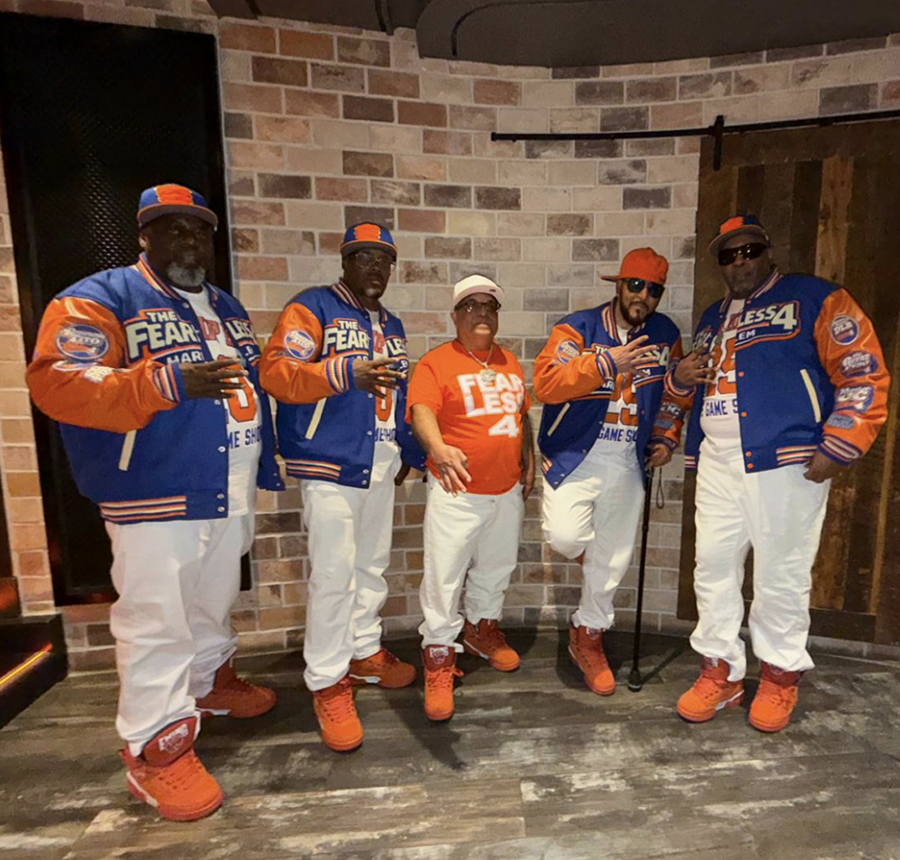
More than four decades after “Rockin’ It,” the music remains part of Hip-Hop’s foundation. When the story of The Fearless Four is told to the next generation, what do you want people to understand about the group, the era you came from and the contribution you made to a culture that went on to change the world?
THE GREAT PESO: To me, when I look at our era and the whole story of The Fearless Four, our music is “graffiti music.” The reason I say graffiti is because, if you look at graffiti, it’s about style, flashiness and creating something people want to take pictures of — something that gets stuck in your brain like a tattoo. The Fearless Four came straight out of the graffiti era.
I call Fearless Four music graffiti music because of our style, our flashiness, our colors and the way we bring those colors together. We have fun with it. The styles we created were risky, almost like graffiti. Everything we did was risky. Ultimately, it’s about having fun and not being afraid to do what you feel will make people happy and bring people together.
That’s what it’s all about: bringing everybody together and enjoying yourself.
When the story of The Fearless Four is told to the new generation, that’s what I want everybody to know about us: our flashiness, our style, the way we tagged the mic and our masterpieces. Our style and showmanship were full of color.
Thank you for these questions. This is Peso 131 — the Great Peso 131 — from The Fearless Four.


