

M-DOT: No Cosign. No Compromise. No Other Way (Interview).
By: Todd “DG” Davis
Rapindustry.com
___
Some artists chase the spotlight. Others put in the work, stay true to where they came from and let the music speak for itself. Boston’s M-Dot has spent more than two decades doing just that. Born Michael Januario, the veteran MC and producer has built his name on sharp lyricism, consistency and an unwavering commitment to hip-hop. Carrying Boston’s underdog mentality with him wherever he goes, he’s never been one to follow the crowd or wait for somebody else to open a door. As a leading member of EMS (Experimental Mind State), he’s built more than a catalog; he’s helped cultivate a brotherhood grounded in loyalty, chemistry and a shared love for the craft.
Along the way, M-Dot has earned the respect of the underground, collaborated with some of hip-hop’s most respected names, including Pete Rock, DJ Premier, Method Man, Erick Sermon and Kool G Rap, and taken his music across Europe on numerous tours. A multiple Boston Music Award winner, he’s continued to evolve without losing sight of the foundation that got him here. His transition into production during the pandemic added another dimension to his artistry, giving him a new creative outlet while strengthening the music he was already making.
That growth comes through on A Notebook With No Light, his latest release and a raw reflection of an artist with plenty left to say. Featuring fellow EMS family, longtime collaborators and an impressive lineup of underground talent, the album embraces the unfiltered expression and musical teamwork that have always mattered to him. There’s no chasing trends or dressing things up for approval—just honest music, hard-earned perspective and a respect for the culture that runs deep.
Time has changed the subject matter, but not the motivation. The experiences are different, the perspective is older, and the music carries the weight of everything that comes with living life. Still writing, producing, touring and representing Boston, M-Dot remains committed to doing things his way.
We caught up with M-Dot to talk Boston’s hip-hop roots, the brotherhood behind EMS, his evolution from MC to producer, the making of A Notebook With No Light and a career built on one enduring principle: doing it his way.
___
Boston has always had its own language when it comes to hip-hop. Coming up in that culture, what did the city teach you about being an MC that you still carry today?
I felt from the get-go that Boston always had a chip on its shoulder, being the little brother of New York. That mentality carried into music for me, with an underdog mindset. All the labels and action were in NYC, which made Boston an environment where people felt they had to leave the city to elevate. Once again, that motivated me to work even harder to see the city lift itself up internally. Why not? That slept-on Boston attitude stays with me today.
You’ve been putting in work for years as both an MC and producer. When did you realize those two sides of your creativity weren’t separate—that the producer and the rapper were actually feeding each other?
I’ve been MCing for what seems like forever. I just got into producing during COVID (2020). I came home from a tour in Europe when they shut the borders, and that accelerated the process of learning how to produce. Being locked down in my apartment at the time gave me the space I needed to concentrate on learning how to make beats. It’s something I always wanted to achieve. The producing aspect is so addictive, and it has definitely helped my writing. That being said, the approach feels separate for me, at least, between pulling thoughts together to be creative with a song concept (writing) and having the freedom to put sounds together for production.
EMS has become part of your musical DNA. What did being around that crew and artists like Kore teach you about chemistry, loyalty and building something that lasts?
EMS is such a special team of brothers. That’s what separates us. It’s a family. There are no yes-sayers. We try to make each other better for the greater good. I’m lucky to have great friends. There is something special about continuity and consistency when building a foundation from the ground up, which still stands.
A Notebook With No Light is a powerful title. What does that notebook represent to you—the things you couldn’t say out loud, the things still being written, or something deeper?
The album was music I felt was too raw for the radio, but also could be a diamond in the rough for people who dig it up and bring it to the light.
“All The Same” brings you and Kore together, with Rawmatik behind the boards and DJ Jean Maron on the cuts. What made this particular combination feel right for the record?
I did that song on tour in Budapest. Then we shot it at an old mental asylum. The beat felt chaotic, so it brought forth that unhinged emotion. Jean Maron sent in scratches afterward. It worked, I guess. Initially, the song wasn’t going to make the album. It was a last-minute addition. I didn’t think it blended or was as strong as the other songs. Ironically, it became one of the most-listened-to songs on the project. It always works that way, lol.
The video was shot while you were on tour in Budapest. How did being thousands of miles from Boston change the energy of a song that comes from such a deeply rooted hip-hop culture?
We’ve shot so many videos over the years out in Europe, and it’s still humbling and cool each time, nonetheless. The culture of Europe and the old-world feel are forever inspiring.
There’s something beautifully old-school about hearing an MC, a producer and a DJ all contribute something distinct to one record. Do you think that kind of musical teamwork gets enough love in today’s hip-hop?
I don’t even hear hip-hop on the radio anymore, so it’s tough to say. I do think good music is out there and still utilizes the elements. You just have to dig deeper to find it. But it’s definitely still there. It’s there with us and the circles we run in. Respecting the culture should be rule number one.
You’ve built your career without chasing whatever happens to be hot at the moment. How important has it been to protect your own sound and let the music grow on its own timeline?
It’s the only way. Do it right. Be yourself. Vulnerability and being sincere will always separate you. Most are afraid, though.
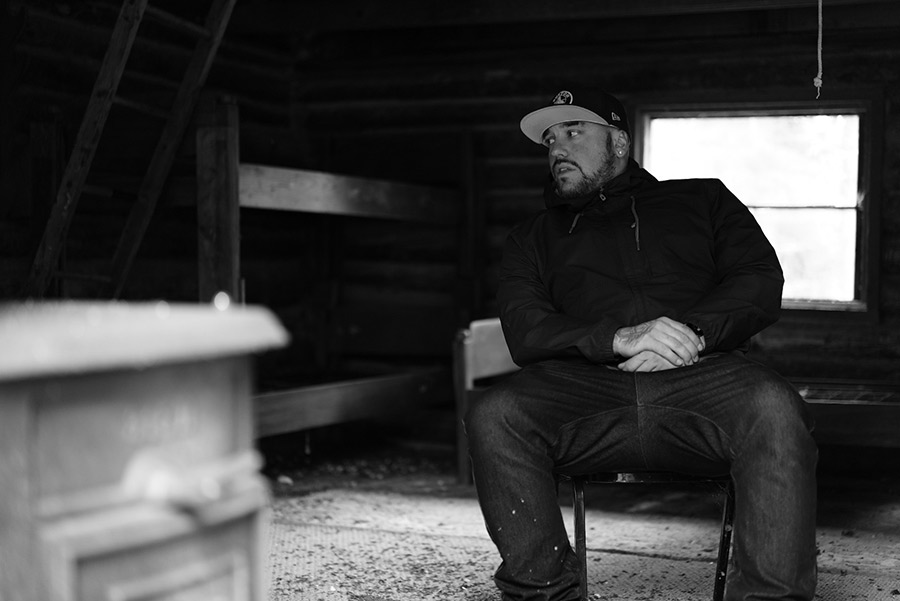
After years of independent hip-hop, touring and building a catalog, what still gives you that same hunger you had when you were first picking up the pen and stepping behind the boards?
Yeah, I’m just as motivated. Writing can sometimes be more work when it comes to thinking of new, creative songs rather than just braggadocio raps. Producing, though, is something I could do every day, and it has given me new excitement. I love music overall, and I’m more driven than ever. I’ve seen hard work pay off. It’s all about staying the course.

Boston has produced generations of serious lyricists, but every generation has to find its own voice. What do you feel you’re contributing to that Boston lineage right now?
I feel I’ve contributed consistency, repping the city everywhere I go and never wavering on who I am or what I represent. That should be what matters most at the end of the day: knowing you did it the right way.
Looking back at the younger M-Dot versus the artist you are today, what has changed the most—your writing, your production, your perspective, or simply the things you have lived through?
I do grown-man music now, for sure, haha. Everything is about perspective. The music I make now involves more pain. As you get older, you lose more people you love. Overcoming adversity is also a key component of the music for me now.
When people close A Notebook With No Light and sit with the whole picture, what do you hope they understand about M-Dot—not just the MC or producer, but the person behind the music?
That I did it MY WAY, like Sinatra, lol.
Thanks for having me.


