

Doug Rasheed: Beyond The Boards — The Soul Behind Hip-Hop’s Greatest Moments (Interview)
By: Todd “DG” Davis
Rapindustry.com
___
Every generation has a soundtrack. Every era has those rare songs that don’t just play in the background—they become woven into people’s lives. They remind you where you were, who you were with, what you were feeling, and what the world looked like at that exact moment.
In the mid-1990s, one of those songs came out of nowhere and changed everything. A haunting melody. A powerful message. A voice that captured the struggle between survival and consequence.
“Gangsta’s Paradise” wasn’t just a hit record—it was a cultural phenomenon. It crossed neighborhoods, radio formats, and generations. It became the kind of song that turned a hip-hop record into a piece of history.
Behind that moment was Doug Rasheed. But the story of Doug Rasheed is bigger than one diamond-certified classic.
Long before the awards, platinum plaques, and worldwide recognition, Rasheed was a young creative searching for his place in the music industry. Leaving San Diego for Los Angeles, he wasn’t handed a seat at the table—he found a way into the room. His vision, persistence, and ability to hear beyond the obvious eventually connected him with some of the most important artists of his generation.
He wasn’t simply making beats. He was creating emotional landscapes.
That same cinematic approach would lead him to work with Coolio, Tupac Shakur, Montell Jordan, Brandy, Whitney Houston, Chaka Khan, and others—artists who understood that the right producer doesn’t just provide sound, they help capture a feeling.
During the legendary All Eyez On Me era, Rasheed helped shape Tupac’s “Only God Can Judge Me,” a record that decades later still carries the weight, honesty, and defiance that made Pac a voice for millions.
That’s the mark of a true architect. The record survives because the emotion survives.
But every legacy has chapters people never see. The victories, the setbacks, the business battles, the moments of reinvention, and the personal transformation behind the music.
Doug Rasheed’s journey is not just about creating some of hip-hop’s biggest records—it’s about rebuilding, evolving, and understanding that success is measured by more than charts and trophies.
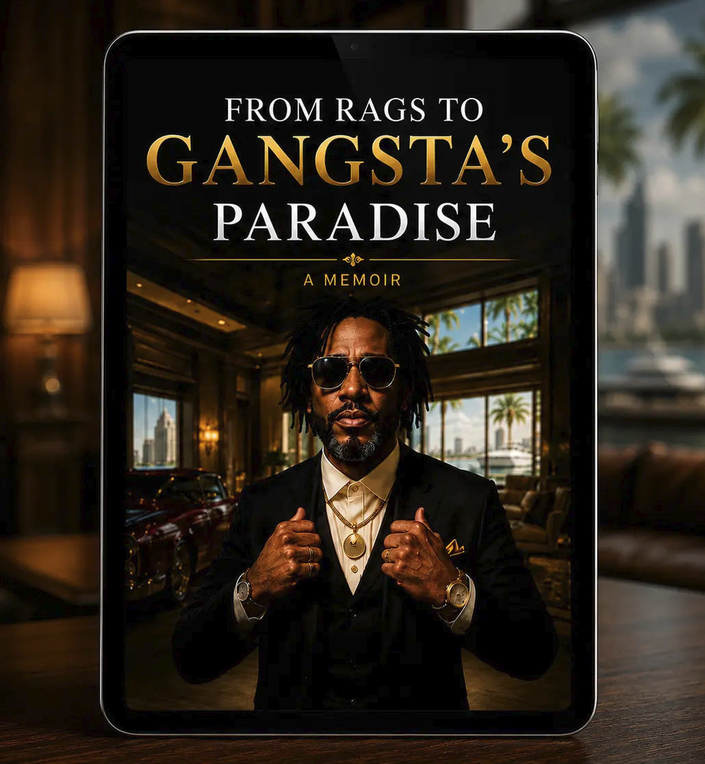
His memoir From Rags To Gangsta’s Paradise tells the story behind the songs and the man behind the music—a journey from struggle to redemption, from uncertainty to purpose.
Today, through MadCastle Media and his continued creative work, Rasheed remains focused on building something bigger than a hit record. Because hits come and go.
But when you create a moment that becomes part of culture, when your melodies become memories and your production becomes part of people’s lives, that’s something different. That’s legacy. And Doug Rasheed has been writing his chapter in hip-hop history one note at a time.
__
Doug, when people talk about the soundtrack of the ’90s, your fingerprints are all over it. Did you realize at the time you were creating records that would outlive trends and become part of hip-hop history?
Doug Rasheed: The short answer is no. I moved to L.A. from San Diego—Daygo, if you’re a native and from the hood—and immediately found myself struggling to fit into the local music hierarchy.
I came up with a plan to get a job at Sony Pictures Entertainment so I could be close to film, television, and music. Through that, I ended up meeting some influential people in hip-hop, which eventually led me to Coolio.
When I created the beat for “Gangsta’s Paradise” and Coolio laid his verses, I knew we had something special, but I never could have imagined what it would become in the long run.
It wasn’t until I worked with Tupac that I started feeling like I might become part of something that would go down in history.
“Gangsta’s Paradise” wasn’t just a hit record—it became a cultural moment. When you hear it today, what memories come back that the public never got to see?
Doug Rasheed: Unfortunately, many of those memories are sad for me because when the song was picked up by the film Dangerous Minds, the relationship changed—for the worse—with the crew I was working with, including Coolio. But over time, I was able to process what we accomplished and enjoy the fruits of our labor in peace. Today, I can truly appreciate it. I’m amazed by what we were able to create.
You helped transform a Stevie Wonder composition into one of the most recognizable records ever made. Looking back, what was the biggest creative risk you took with “Gangsta’s Paradise”?
Doug Rasheed: Stevie already had an everlasting classic with “Pastime Paradise.” I was fortunate that he cleared us to use it. Creatively, there really wasn’t much risk because the foundation was already so powerful. The bigger risk was potentially losing ownership of the record. I’m grateful we were able to retain 25% to split between myself, Coolio, and L.V.
Working with Coolio, Tupac, Montell Jordan, Brandy, and others, what separated the artists who became timeless from those who simply had hot records?
Doug Rasheed: Honestly, Tupac is head and shoulders above the rest as far as artists go.
In my opinion, it was because he was able to exist beyond the music—he existed in the realm of culture. But I appreciate all of those artists the same because they gave me the opportunity to create with them.
Your records always carried soul, tension, and emotion. Were you producing beats, or were you scoring films that artists happened to rap over?
Doug Rasheed: Great question. I’ve always imagined my music from a scoring and soundtrack perspective. I’m not always sure how artists interpreted them, but I know most of them ended up creating something different from anything they had done before or after. That was always my goal.
The chemistry between a producer and an artist is everything. What do you remember most about creating with Tupac during the All Eyez On Me era?
Doug Rasheed: The night we recorded was mostly a blur, with moments that stand out—especially he and I trading ideas on how to finish the songs.
Like me, Pac kept things simple and stayed focused on the task at hand. But what I remember most about our chemistry happened afterward. Even with all the chaos surrounding Death Row, he still reached out to me several times during the six months before he was murdered. He even asked me to become part of his upcoming Euphanasia Records label that Quincy Jones was helping him develop.
Late one night, he called me out of nowhere and asked me to come hang out at Can-Am Studios. It was the night he recorded “Hit ‘Em Up.” I was exhausted from a 12-hour recording session and tried to decline, but he insisted I come. To this day, it still amazes me that he picked up the phone, called me, and insisted that I come out there just to hang out. Of course, I went. That is my most powerful memory of him. I have many more that I talk about in my memoir. Pac has his own chapter.
“Only God Can Judge Me” still resonates nearly 30 years later. Did you and Pac know you were capturing something bigger than a song?
Doug Rasheed: Again, the short answer is no. I was just focused on whether we had a single or not.
The last time I saw Pac alive, I was driving down Sunset Boulevard and saw him standing outside a hotel. I pulled over, and we talked for a few minutes. He told me “Only God Can Judge Me” was going to be the third single, and I was ecstatic. Looking back, I’m even happier with the cult-like status the song developed over the decades.
The streets always tell the truth.
Some producers chase hits, while others build worlds. When artists came to Doug Rasheed, what do you think they were really coming for?
Doug Rasheed: I’ve never been the type of sought-after producer where artists were constantly knocking down my door like someone such as Dr. Dre, and I’ve always been okay with that. Most of my work has come through local artists or relationships built through the industry. Even today, I still seek out local talent.
The soundtrack for my memoir is a perfect example. I only feature local artists from Charlotte, Daygo, and L.A. on that project.
You’ve witnessed the music business through multiple eras—from physical sales and radio dominance to streaming and social media. What’s been the biggest lesson from surviving all those changes?
Doug Rasheed: The biggest lesson is that there are always new opportunities. New technology creates new possibilities. I personally love it because it gives the little guy the opportunity to market themselves on a worldwide stage, even without major-label support. You just have to learn the game, create a plan, and execute using the tools available.
Your memoir is called From Rags to Gangsta’s Paradise. Looking back on the entire journey, what chapter shaped you the most as a man, not just a producer?

Doug Rasheed: The dopest question ever. Definitely Chapter 10, “Asian Nights: A Chance at Redemption.”
That chapter is where my transformation happens. Before that, I was living a life that probably wasn’t going to end well. Living in Tokyo gave me a different sense of power. It showed me that a Black man wasn’t hated everywhere he went, and that was something that used to weigh heavily on me. Over there, we were like superheroes. After two years of performing and living in Tokyo, I understood my true potential. It changed me deep down in my soul. I was ready for the world after that.
There are countless producers with platinum plaques, but only a handful have records that become part of people’s lives. What does that distinction mean to you today?
Doug Rasheed: There are many producers I admire for what they’ve contributed to the culture. Me? I’m just proud of myself because as a youngster, I couldn’t even imagine basic success in life, let alone the kind of impact my music has had on pop culture. It’s still surreal to process even today. But I feel blessed and highly favored, as they say in the South.
Between Madcastle Media, new creative ventures, and everything you’ve accomplished, what still motivates Doug Rasheed to get up and create?
Doug Rasheed: I want to build a brand and use it to help underprivileged people. Building a brand has always been difficult for me because I don’t follow trends, and I never have. Over the years, I’ve learned that developing skills beyond creativity is important. It took me many years to understand that. But I’m stubborn, so I stuck with it.
Today, I feel like I’m on the verge of launching something successful, and that means more to me than any hit record. I’m motivated by achievement, the same way I always have been.
Fifty years from now, when people study the records that helped define hip-hop’s Golden Era, what do you hope they say about Doug Rasheed’s contribution to the culture?
Doug Rasheed: I just hope history doesn’t get rewritten in a way that excludes me from my contributions. I hope my current and future projects become even bigger than the music. But most importantly, I hope people in the future appreciate what I brought to the culture.


