
Three Icons. One Message. FREEDOM. (Darryl McDaniels, Johnny Juice, Brian Hardgroove)
By: Todd “DG” Davis
Rapindustry.com
___
When pioneers speak, culture listens. Darryl McDaniels of Run-DMC, legendary Public Enemy producer/DJ Johnny Juice, and bassist-musical architect Brian Hardgroove aren’t revisiting the past with FREEDOM — they’re responding to the present.
At a time where division, noise, and empty outrage dominate everyday life, FREEDOM arrives with purpose. Their debut single, “I’m On Your Side” — dropping May 15, 2026 — blends militant hip-hop energy, rock grit, soul, and social consciousness into something that feels urgent instead of nostalgic.
This isn’t manufactured activism or legacy artists chasing relevance. DMC’s commanding voice, Johnny Juice’s layered production, and Hardgroove’s live-wire musicianship come from decades spent understanding that music is supposed to move people emotionally, spiritually, and culturally.
“I’m On Your Side” feels like a rally cry for people exhausted by silence, confusion, and disconnection — a reminder that music still has the power to challenge, unite, and heal without watering itself down for trends or algorithms.
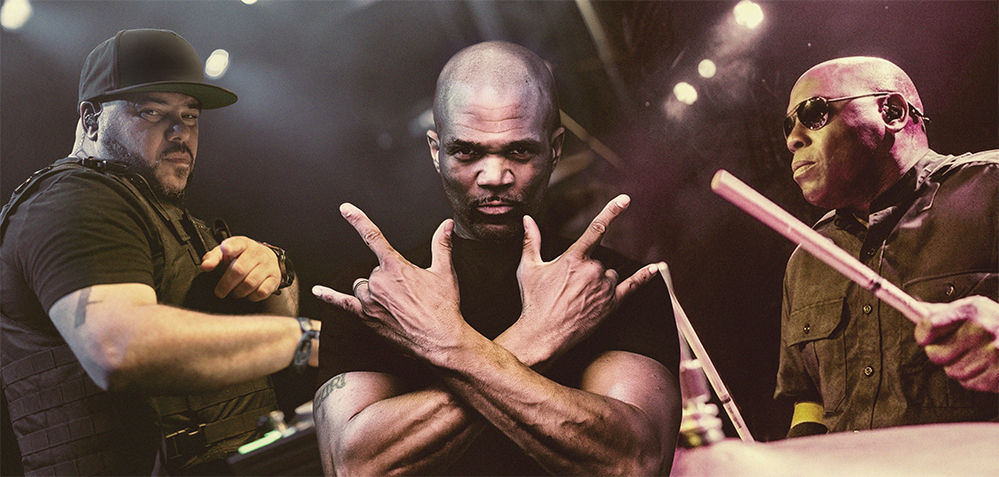
More than a band, FREEDOM feels like a statement: the architects who helped build the culture still have something important to say… and they’re saying it louder than ever.
We recently caught up with Johnny Juice to talk shop.
When you look back at your time helping shape the sound of Public Enemy, what’s something you contributed that people still don’t fully recognize or understand?
I feel the most important thing I contributed to Public Enemy’s sound was being able to add just the right element needed to make a song feel complete. Sometimes it was a sample. Sometimes it was the right type of scratch. Sometimes it was arrangement. And sometimes, it was the total production.
FREEDOM isn’t just another project—what was the exact moment you knew this wasn’t nostalgia, but something necessary right now?
FREEDOM actually started a couple of years ago as a different project. We recorded a few songs, but schedules, commitments, and other things prevented it from fully coming together. Fast forward to 2025—Public Enemy was performing at the Sea.Hear.Now Festival, and I invited Darryl McDaniels to perform with us. Darryl mentioned to Brian Hardgroove how much he loved one of the songs we performed, “I’m On Your Side,” and said we needed to get that record out to the masses. That night, Hardgroove listened back to the song and realized now was the time to release it. That realization became the beginning of FREEDOM.
You’ve always operated behind the boards as much as in front—what part of your creative process has never changed, no matter who you’re working with?
No matter who I work with, or in what capacity, the artist’s vision and message need to be delivered as accurately as possible. If I’m producing, I focus on helping the artist communicate their message with passion and integrity. If I’m performing with an artist, that mindset still doesn’t change.
There’s a difference between making noise and making impact—what does impact actually mean to you at this stage of your career?
To me, impact is when your art affects people in a way that changes their lives or even the trajectory of their lives. You can be hot. You can be popular. There’s nothing wrong with that. But there’s something transcendent about being an IMPORTANT artist.
Working alongside Darryl McDaniels and Brian Hardgroove, what conversations are happening off record that are shaping the energy of FREEDOM?
Those conversations are really the foundation of FREEDOM. The group came together because of a shared mindset regarding art, culture, social responsibility, and life itself. Nobody was recruited for this project. The pieces just naturally fit together.
Hip-hop started as disruption—do you feel like that original intention got diluted, and is FREEDOM your way of correcting that?
Most revolutionary music and the cultures surrounding it begin as divergent movements out of necessity. Hip-hop is no different than punk rock or jazz in that respect. FREEDOM contains elements from many musical styles and genres, including hip-hop. Our message addresses issues that go beyond any one genre or subculture.
You’ve seen generations of artists come and go—what separates the ones who last from the ones who just ride a moment?
The artists who last are the ones who actually have something meaningful to say. Empty music is like empty calories. It may work as a guilty pleasure for a while, but that doesn’t last long.
“I’m On Your Side” speaks directly to division and tension—how do you balance making something emotionally powerful without it becoming just another slogan?
That’s a good question. I think of it like this: You can either create a slogan and then write a song around it, or you can write something so profound that it eventually becomes a slogan.
As a DJ and producer, what immediately tells you whether an artist is authentic or manufactured?
Perspective. Most people experience trials, trauma, setbacks, and pain. I can usually tell who’s authentic not by WHAT experiences they talk about, but by HOW they talk about them—how they perceive them. Our perspective shapes our voice. There’s an old story about two brothers raised by an alcoholic father. One becomes an alcoholic and says, “Because my father was an alcoholic.” The other never drinks and gives the exact same reason. Same experience, completely different outlooks. Artists who speak from the soul will always be heard.

There’s a legacy attached to your name whether you acknowledge it or not—what part of that legacy are you still actively building, not just protecting?
I create to express, not impress. Hopefully, my truth affects people positively. If there’s anything I’m actively building, it’s a culture of discipline and consistency. I try to lead by example. If you move with integrity, you don’t really have to worry about protecting a legacy.
If someone listens to FREEDOM and only hears music, what are they missing?
If someone listens to any artist and only hears music, they’re missing something—even if it’s instrumental. There’s always something the artist is trying to convey. With FREEDOM, we’re addressing serious issues, but ultimately we’re trying to provide hope. As Kurt Vonnegut once said, “A purpose of human life, no matter who is controlling it, is to love whoever is around to be loved.” FREEDOM chooses to fight negativity with love.
Ten years from now, when people talk about this chapter—FREEDOM, this moment, this message—what do you hope they say you stood for, not just what you made?
Ten years from now, I would hope the music had such an impact that there would no longer even be a need for a group like FREEDOM to exist.